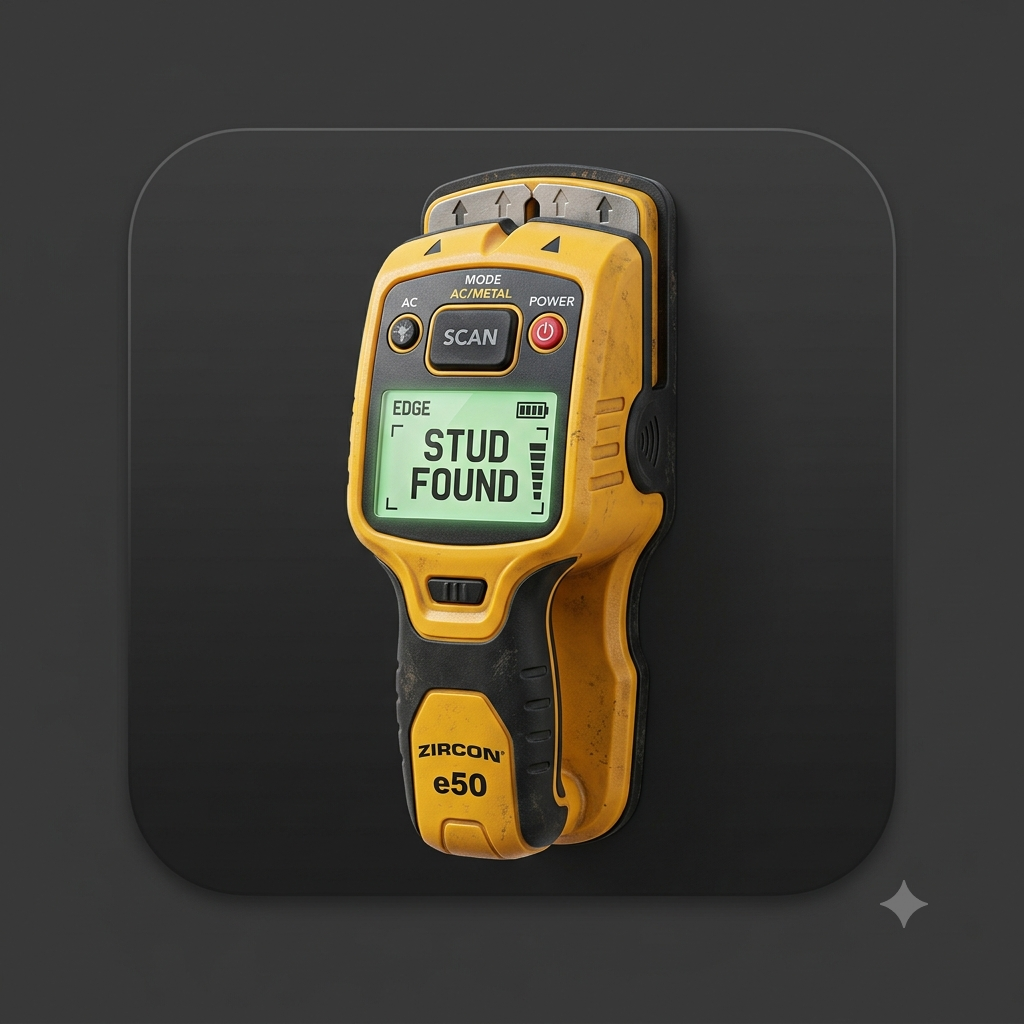
 Stud Finder
Why Floating Shelves Need Stud Support More Than Regular Shelves
Floating shelves have no diagonal brackets or vertical supports underneath. All load is concentrated on the mounting plate and the wall anchors. When you place books or dishes on the shelf, gravity exerts downward shear force, while leverage exerts outward tensile force, attempting to pull the top of the bracket away from the wall. Drywall anchors will slowly loosen and sag under this constant tension. Securing the mounting bracket to structural wood studs is absolute necessary to prevent wall collapse [1].
Finding and Marking the Exact Center of Wood Studs
Use a magnetic stud finder app to locate the drywall screws along the wall. Mark these points. Since studs are 1.5 inches wide, finding the center ensures the mounting screw has maximum wood support. Scan horizontally to find where the signal peaks, marking the center. Repeat this process at the height of the shelf. Draw a vertical line connecting the marked centers to ensure your screws align with the middle of the studs.
What to Do If Your Shelf Bracket Holes Don't Line Up with Studs
Floating shelf brackets have pre-drilled holes, but they rarely match the exact spacing of your wall studs (which are 16 inches apart). Do not use drywall anchors as a workaround. Instead, use a metal drill bit to drill new mounting holes through the steel bracket plate at the exact spacing of your studs. This allows you to mount the bracket securely to the studs while keeping the shelf centered exactly where you want it.
Pre-Drilling and Securing the Bracket: Tools and Hardware Selection
Use structural wood screws (such as GRK or Spax screws) instead of standard drywall screws. Drywall screws are brittle and can snap under tension. Pre-drill pilot holes to prevent the wood studs from splitting. Hold the bracket against the wall, check that it is perfectly level using a bubble level, and drive the structural screws into the studs until the bracket is flush and rigid [2].