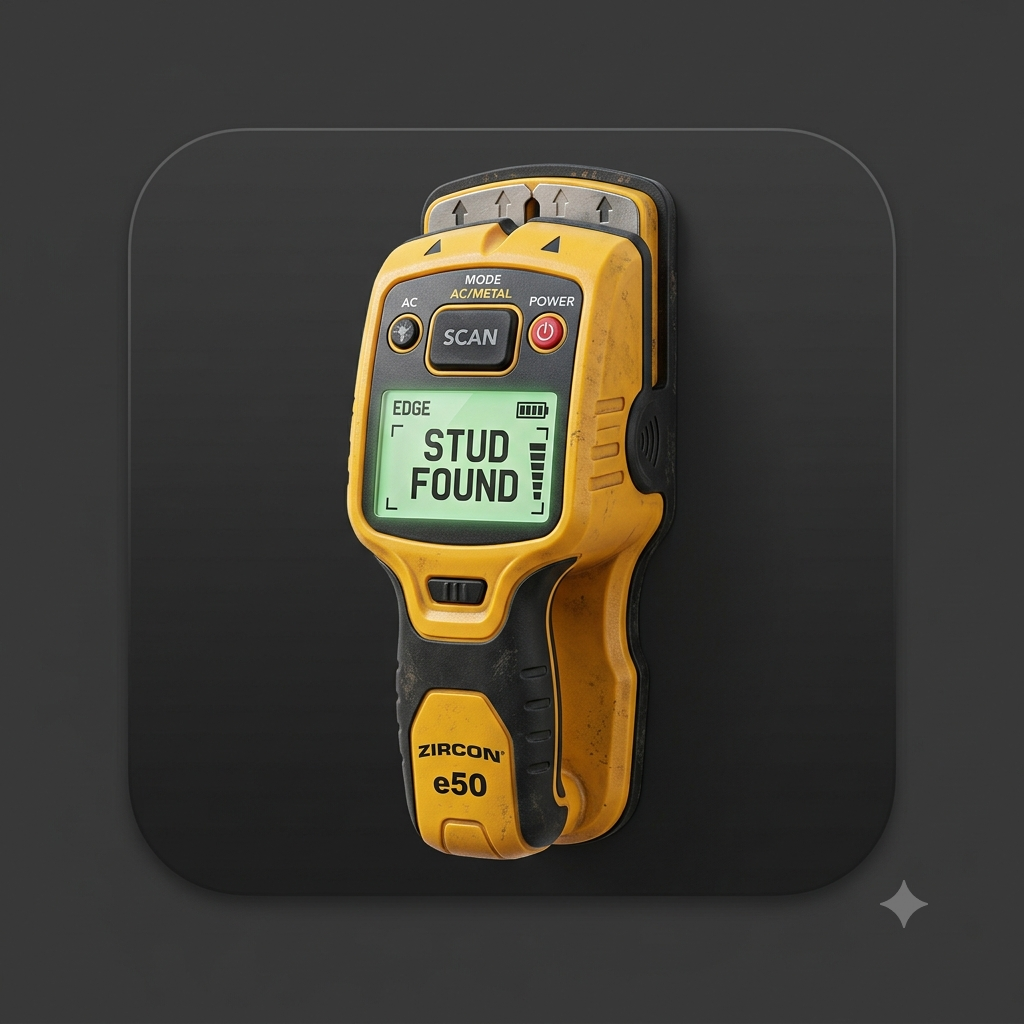
 Stud Finder
What is a Magnetometer and Why is it in Your Smartphone?
Your smartphone contains a three-axis magnetometer, a solid-state sensor that measures the strength and direction of local magnetic fields in microteslas (µT). This chip is essential for navigation, allowing apps like Google Maps to know which direction you are facing. The magnetometer is incredibly sensitive, detecting minor changes in magnetic flux. Fasteners like steel drywall screws or nails concentrate magnetic lines of force, creating a measurable field distortion that the app can detect.
How Apps Translate Magnetic Field Strength (Microteslas) into Visual Signals
A magnetic stud finder app reads the raw sensor data from the X, Y, and Z axes. It then computes the total magnetic field magnitude using the vector magnitude formula: B = sqrt(Bx² + By² + Bz²) [1]. The earth's background magnetic field typically registers between 30 and 50 µT. As your phone passes over a steel nail or screw, the reading spikes (often to 70–90 µT). The app translates this value in real-time into a visual graph and an audible beep.
Metal vs. Wood: The Limitations of Magnetic Detection
It is physically impossible for a smartphone sensor to detect wood. Wood is non-magnetic and has no effect on magnetic fields. Therefore, magnetic stud finder apps do not detect the wood stud itself; they detect the steel screws and nails that hold the drywall to the stud. While this allows you to map out where the studs are, it requires you to scan vertically to find the fastener line. Note that the app will also detect copper pipes (which are diamagnetic but may distort the field slightly) and steel plumbing pipes.
How to Calibrate and Maximize the Accuracy of Your Phone's Magnetometer
Calibration is vital for reliable magnetic readings. Wave your phone in a figure-eight motion to reset the magnetometer's internal offsets [2]. Additionally, remove any phone cases that contain metal, magnets, or credit cards, as these will shield the sensor or trigger a permanent 'stud detected' reading. Scan slowly to allow the sensor to capture the localized magnetic peak.