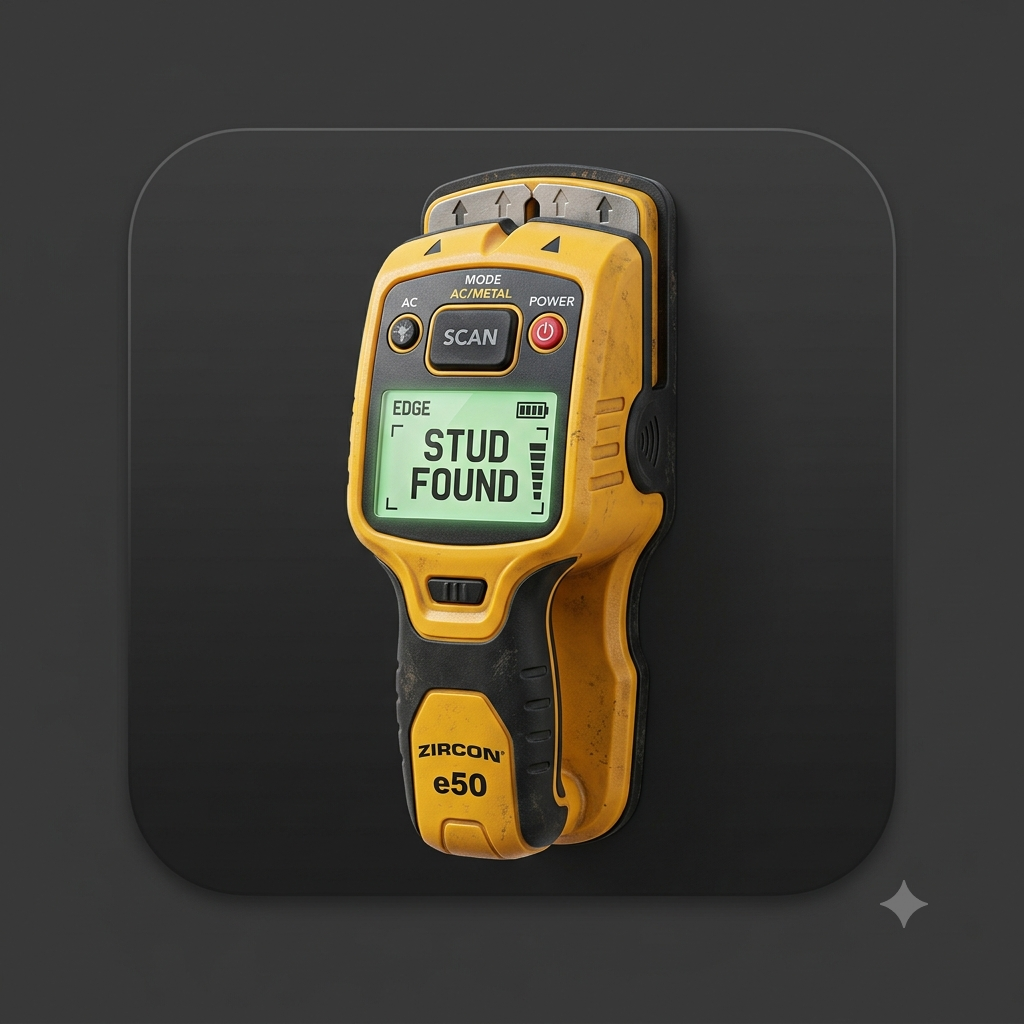
 Stud Finder
Understanding Ceiling Joist Spacing and Direction
Ceiling joists are the horizontal structural beams that support the ceiling drywall and the floor above. They typically run perpendicular to the ceiling drywall sheets and parallel to the roof rafters. Standard joist spacing is either 16 or 24 inches on-center. Knowing which direction your joists run is the first step; they usually run the shortest span of the room. You can verify this by checking the framing in your attic or crawlspace [1].
The Knock and Tap Test: Sounding Out the Ceiling
Tap the ceiling with your knuckle or a small hammer handle. The areas between joists will sound hollow and resonant. As you tap directly under a joist, the sound will change to a higher pitch and a solid, muted thump. Tap in a straight line across the room to map out where these solid points occur, then measure the distance between them to verify they match standard 16-inch or 24-inch joist spacing.
Using Magnets to Trace Ceiling Fasteners
Ceiling drywall sheets are secured to the joists using drywall screws or nails. A magnetic sensor app or a neodymium magnet is highly effective for finding joists. Run the app slowly across the ceiling. The app will detect the steel screws driven into the joists. Once you find one screw, you can easily measure exactly 16 or 24 inches perpendicular to trace the neighboring joists, confirming their path by finding additional screws along that line [2].
Safe Drilling and Verification Methods for Ceiling Mounts
When hanging heavy items like ceiling fans, light fixtures, or hanging chairs, you must ensure a solid wood connection. Drill a tiny pilot hole using a 1/16-inch bit. If you feel resistance all the way through 1.5 inches, you have hit the joist. If the bit punches through after 1/2 inch of drywall, you missed the joist. Avoid drilling deeper than 1.5 inches to prevent damage to electrical cables or HVAC ducts resting on top of the joists.