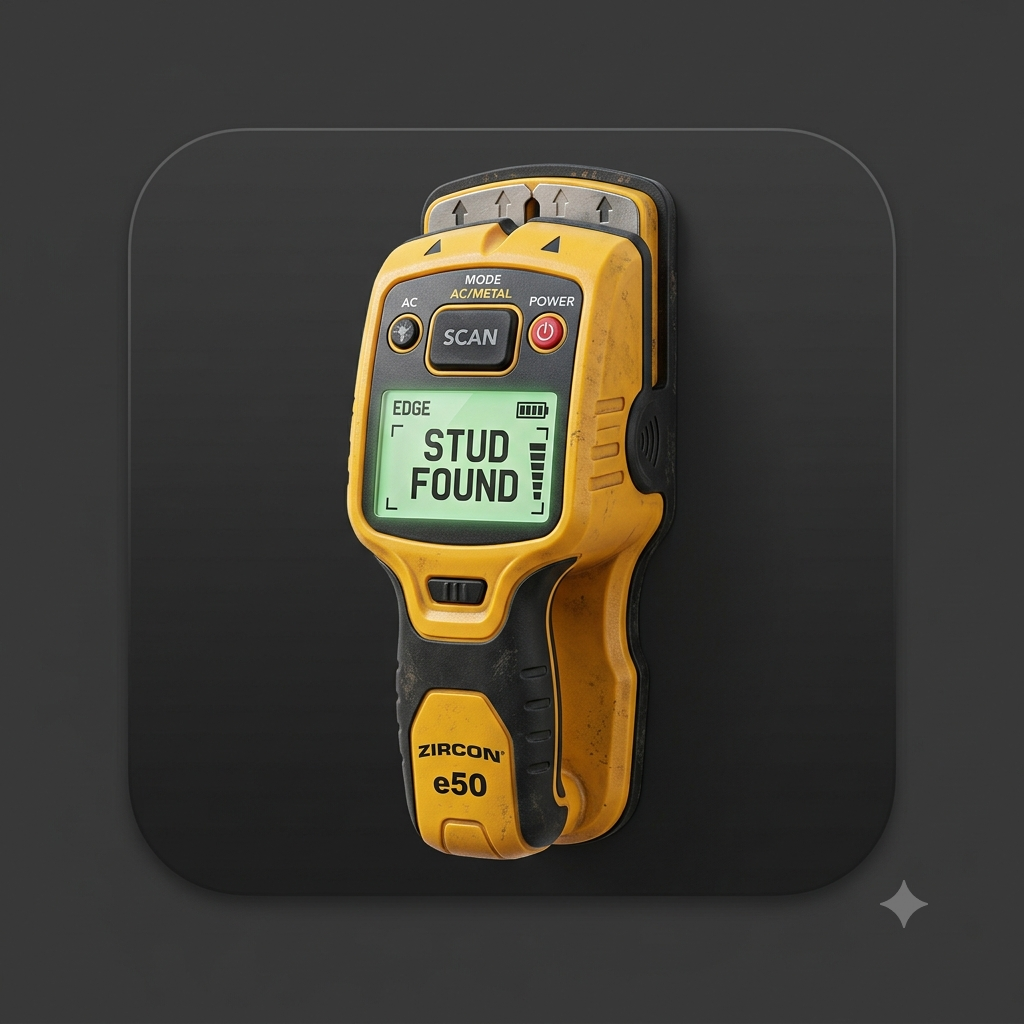
 Stud Finder
How Smartphone Magnetometers Detect Metal in Walls
Every modern smartphone is equipped with a micro-electromechanical system (MEMS) magnetometer, a tiny sensor that measures magnetic flux density in microteslas (µT) along three spatial axes [1]. This sensor is primarily built to power compass applications and improve mapping orientation. However, because steel drywall screws and nails are ferromagnetic, they warp the earth's natural magnetic field in their immediate vicinity. By sliding your phone directly against the drywall, the magnetometer detects these local magnetic spikes, allowing you to accurately pinpoint where the drywall was secured to the vertical framing studs.
Limitations of Phone Stud Finder Apps vs. Dedicated Scanners
It is crucial to understand that a phone app does not function like a commercial capacitive stud finder. Capacitive scanners measure variations in dielectric constants, allowing them to directly sense the density of wood or metal behind drywall [2]. A smartphone app cannot see wood. It operates strictly by detecting the steel fasteners (screws or nails) embedded within those wood studs. While this means the app is highly reliable for finding the lines where studs are located, it cannot directly measure the edges of a wood stud itself, and it is limited by the depth of the metal fasteners.
Best Practices for Using a Phone App to Locate Studs
To achieve maximum accuracy with a smartphone stud finder, follow these critical guidelines: First, remove any protective phone case, particularly those with magnetic clips, kickstands, or built-in metal plates, as these will completely disrupt the magnetometer. Second, calibrate your phone's sensor by waving the device in a figure-eight motion before scanning. Finally, lay the back of the phone flat against the drywall and slide it very slowly horizontally. Fast movements can bypass the localized magnetic spike of a small drywall screw.
- Remove all obstacles: Heavy-duty phone cases containing magnets, steel components, or cards must be removed before scanning.
- Move slowly: Magnetic fields decrease rapidly with distance, so a slow sweep gives the sensor time to read the peak.
- Verify vertically: Once a spike is found, move vertically. If it triggers spikes every 8-12 inches, it is a wood stud with screws. If it is continuous, it is metal.
Wood Studs vs. Metal Studs: What Your Phone Can Actually Find
Your phone is highly capable of identifying whether a stud is wood or metal. When scanning a wall with wood studs, you will detect discrete, localized magnetic spikes spaced vertically (usually every 8 to 12 inches) where drywall screws are driven. Between these screws, the magnetic reading will return to background levels. In contrast, metal studs are constructed of steel channels that run continuously from floor to ceiling. Scanning a metal stud will yield a strong, continuous magnetic pull along its entire vertical path, making them very easy to trace.